
Destination
Destination
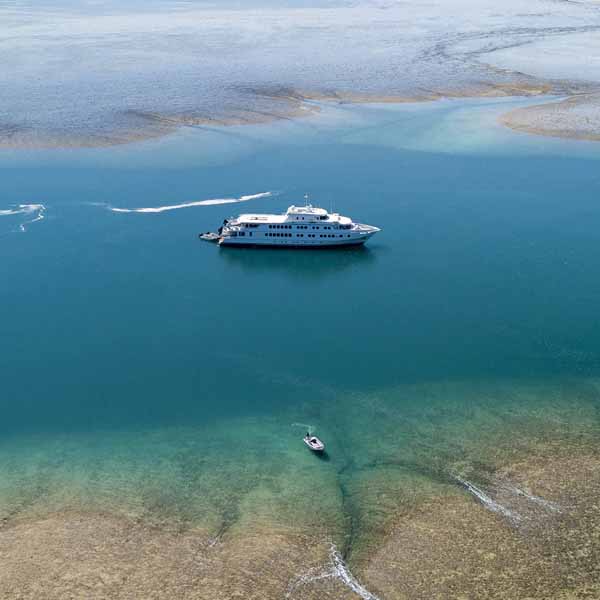
As each enormous Kimberley tide retreats, Montgomery Reef appears to rise out of the sea, shedding water in spectacular cascades and countless waterfalls. Marine creatures race over the edge of the rapidly drying reef to the safety of the sea, creating spectacular scenes unequalled anywhere in the country. At over 300 square kilometres, this is Australia’s largest inshore reef, found 20km off the central Kimberley Coast in Lalanggarram/Camden Sound Marine Park.
Montgomery Reef is renowned for its extraordinary tidal dynamics. As the tide drops, the water rushes away, revealing a massive reef that seems to rise from the ocean. Waterfalls cascade off the reef in every direction, creating the illusion that the ocean is draining. The reef spans over 300 square kilometres and stretches about 80 kilometres in length, making it the largest inshore reef in the world.
Montgomery Reef is a haven for a diverse array of marine life. The reef’s ecosystems support various species, including turtles, dugongs, crocodiles, and a multitude of fish. The dynamic tidal flows create a rich environment for these creatures, offering abundant feeding and breeding grounds. Observers can witness turtles bobbing to the surface, reef sharks weaving through the shallows, and seabirds diving in for an easy feed.
The Worrora people are the traditional custodians of this important Humpback whale nursery, known as Yowjab in the Dambinmangari language. The reef is home to Australian snubfin and Indo-Pacific humpback dolphins, dugong and threatened marine turtles, and estuarine crocodiles have been spotted sunbaking on the reef. Montgomery also displays a variety of vibrant, coloured coral.


Long before Montgomery Reef became a regular stop on Kimberley expedition cruises, Australian naturalist and filmmaker Malcolm Douglas was taking audiences into this remote corner of Western Australia. Douglas was (and still remains, in legacy) one of Australia’s best-known wildlife filmmakers and adventurers, and his films helped introduce generations of Australians to the landscapes, wildlife and Indigenous cultures of the remote north.
Montgomery Reef featured prominently in several of Douglas’s Kimberley films. In Beyond the Kimberley Coast, released in 1976, Douglas travelled by open boat with a small group from a coastal Aboriginal community to Montgomery Reef, where they camped on the islands. The film documented the journey through this largely inaccessible coastline as well as traditional hunting and cave-painting practices.
Douglas returned to the region in North From Broome with Malcolm Douglas in 1982. The journey took him along the north-west Kimberley coast, including the Lacepede Islands, Montgomery Reef, the Prince Regent River and Talbot Bay. Montgomery Reef also appeared in Travelling True North with Malcolm Douglas (1985), which followed a journey along the Kimberley coast by charter boat and included the reef, waterfalls and rivers of the region.
The footage is particularly interesting today because it captures Montgomery Reef at a time when the Kimberley coast was still little known to the wider Australian public. Douglas’s films showed the extraordinary effect of the Kimberley’s enormous tides, with seawater draining from the reef and appearing to cascade over its edges as the reef emerged from the ocean.
His connection with Montgomery Reef went beyond filmmaking. Douglas was also a long-time advocate for protecting the Kimberley wilderness. In 2007, he campaigned for World Heritage listing for a large area incorporating Montgomery Reef, Collier Bay and the Horizontal Falls, describing the region as pristine wilderness.
Today, Montgomery Reef is one of the signature destinations along the Kimberley coast, visited by expedition vessels and smaller boats that allow passengers to experience the reef from the water. For anyone travelling through the Kimberley, watching Douglas’s early films offers a fascinating glimpse of the coastline before it became the celebrated expedition destination it is today.
